











An outreach meeting with groups focused on natural resources and growth/infrastructure was held on March 25 to discuss data center water and energy use.
The meeting was attended by industry representatives, utility representatives, researchers, tribal members and environmentalists. The meeting was intended to gather information to create a bill in the upcoming 2027 legislative session.
Editor’s Note: AZBEX, our sister publication, has covered data center restrictions across various jurisdictions in Arizona. To view our previous coverage, click here.
NV Energy produced an integrated resource plan in 2024 that found, at the time, 12 data centers would increase the energy load across the state by just shy of 50%. This could serve as an issue, as the state has a set of clean energy goals to meet by 2030.
The utility company noted, however, that natural gas plants could be used to further generate power and close the gap.
Tech companies have also asked smaller utilities, such as the Lincoln County Power District No. 1, for power that measures up to 70 times its current peak. Data centers are quickly spreading throughout both Northern and Southern Nevada.
On the other end of resource consumption, the Las Vegas Valley Water District reported 2025 saw 352.6 million gallons of water consumed across 10 data centers via evaporative cooling.
Notably, evaporative cooling techniques are becoming increasingly less common in new data centers due to water usage. Closed loop systems have become more widely used to reduce water consumption. Supporters pointed to a 2024 study by the Virginia Legislature that found 83% of data centers use a similar quantity of water as a large commercial office building.
Data center opponents stated the facilities are becoming more popular in Nevada due to cheap land and electricity.
A ban on evaporative cooling techniques in new developments was introduced in Southern Nevada in 2024. Lower water usage in data centers generally correlates with more energy usage.
NV Energy is expected to submit an updated version of its integrated resource plan to the Public Utilities Commission of Nevada later this year. The updated plan is expected to request numerous significant power projects to meet the exponentially increasing demand.
Western Resource Advocates predicts the utility company will ask to quadruple its current capacity, with many of the requested projects being speculative.
Local Economic Impact
In 2015, Nevada lawmakers approved Senate Bill 170 to reduce sales and personal property taxes on data centers in an attempt to diversify and strengthen the economy after the Great Recession. Since then, data centers have become largely associated with the artificial intelligence boom.
Over the course of the past decade, projections show Nevada has given out $457M in tax abatements for data center developments. Data center opponents argued the tax abatements have a negative impact on local communities, particularly those in rural areas.
The $457M in abatements over the last 10 years have only created roughly 300 direct jobs. The State does not track tax revenue and economic activity connected to data centers and only considers the projections used to create the tax relief program.
The Nevada Independent found that the last eight years left a $537M gap in sales and tax revenues for local governments. The analysis noted, however, it is unclear what the revenue would look like without the incentives.
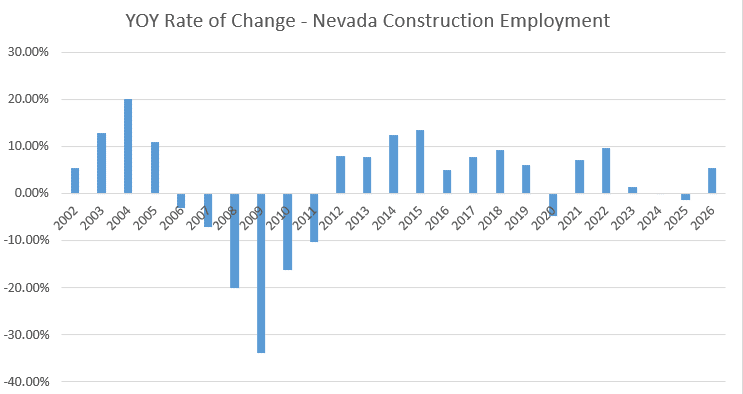
Local construction unions, such as the International Brotherhood of Electrical Workers Local 401, have spoken in support of data centers, saying they have led to significant employment growth in the field. Supporters also noted data centers tend to stoke additional developments surrounding the new facilities.
Several states have conducted studies on the construction of data centers in relation to incentive programs. Georgia’s 2022 study argued 90% of data center construction was a result of incentives; however, its 2025 study argued 70% of data center activity would have happened without an incentive program.