











ROAD to Housing Act Becomes Law by Default

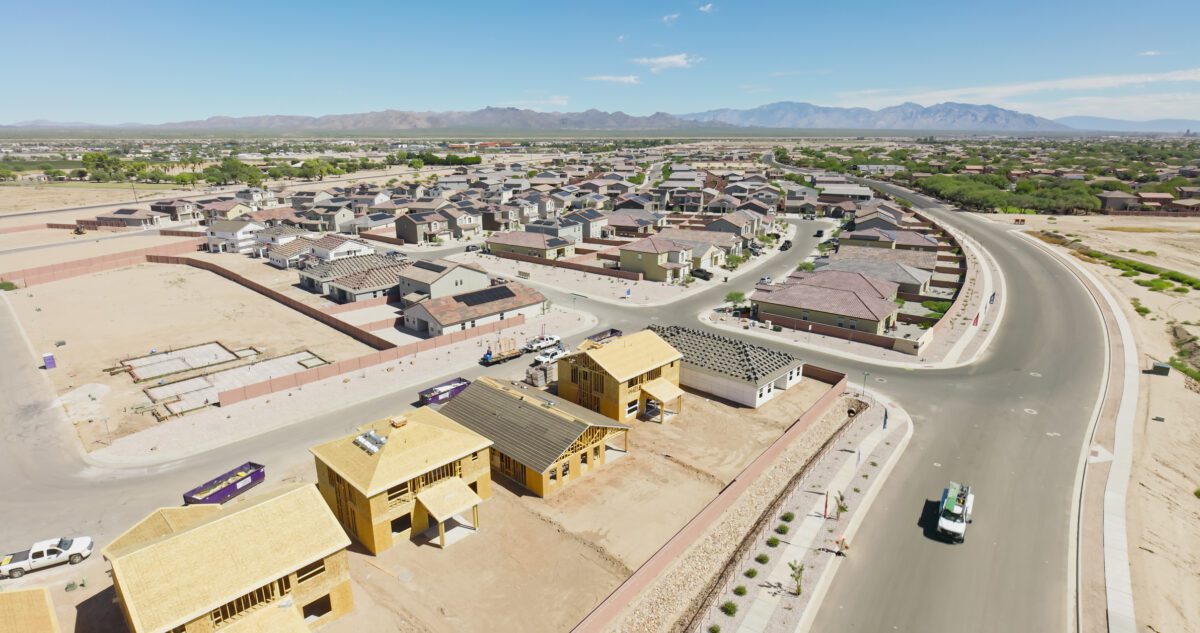
Aerial view of a residential housing development under construction in Marana, Arizona, during the day. The image shows multiple homes in various stages of completion, with wood-framed houses prominently visible in the foreground alongside finished single-family residences with tile roofs. The curved suburban streets wind through the planned community, with construction vehicles and building materials scattered throughout the active construction zone. Desert mountains are visible in the background under clear blue skies, characteristic of the Sonoran Desert landscape surrounding this growing Arizona community north of Tucson.
Credit: KJZZ/Getty Images

The 21st Century ROAD to Housing Act was officially enacted on July 11, despite not being signed by President Donald Trump.

The ROAD to Housing Act is intended to increase the housing supply by easing pressure created by regulations.

President Trump refused to sign the bill in an attempt to persuade Congress to sign a voter ID bill, saying on social media, “I will not sign the Housing Bill, which has been fully approved by Congress and sent to the White House, in PROTEST over the fact that the United States is not capable of passing THE SAVE AMERICA ACT.”

As Trump let the bill sit without issuing a veto or signing it into law, it went into law by default 10 days later.

While many argue the legislation is a good step in battling the affordability crisis, Keller Williams Realty Las VegasChery Toste and Shane Beall stated home buying will not begin to increase until interest rates come down. Beall believes housing stock is currently a decade behind in terms of supply.

The law is being introduced as home prices continue to surge. The median home price in the United States recently hit $440.6K, tying its record, according to The National Association of Realtors. The lack of available homes has resulted in increased prices. Once the supply catches up with demand, however, prices are likely to turn around.

We thought you may also like these articles...
Brightline West Remains Far from Funding Goal
Zilberberg International Proposing 71-Unit Apartment Complex in Downtown Las Vegas
Las Vegas Q2 Construction Cost Percent Change Mirrors National Average
Clark County Next to Consider Data Center Restrictions
Phillips 66 and Kinder Morgan Advancing Western Gateway Pipeline

Leave a Reply

Your email address will not be published. Required fields are marked *

Learn More About Our Services

Mark Hobaica

Mark Hobaica

Executive Vice President

Core Construction

Since 2019, as CORE Construction’s Executive Vice President for Nevada, Mark ensures every client CORE serves receives the highest level of personalized care for every project. Mark’s passion is client Trust. He cares deeply about CORE’s reputation, partnerships and providing the highest quality and services, as well as most honest and best value possible. He has worked in the Las Vegas Valley and for the Public Works sector for nearly 35 years. He began as an owner in a local architectural firm designing and overseeing projects for Public Works clients for nearly 12 years. He clearly understands the expectations of the public sector, as he then directed numerous projects for over 16 years as the City Architect for the City of Henderson. His focus has always been delivering projects using CMAR or Construction Manager at Risk as he has implemented dozens of projects with his trusted approach, while always involving every stakeholder to ensure each individual receives the highest level of services expected.